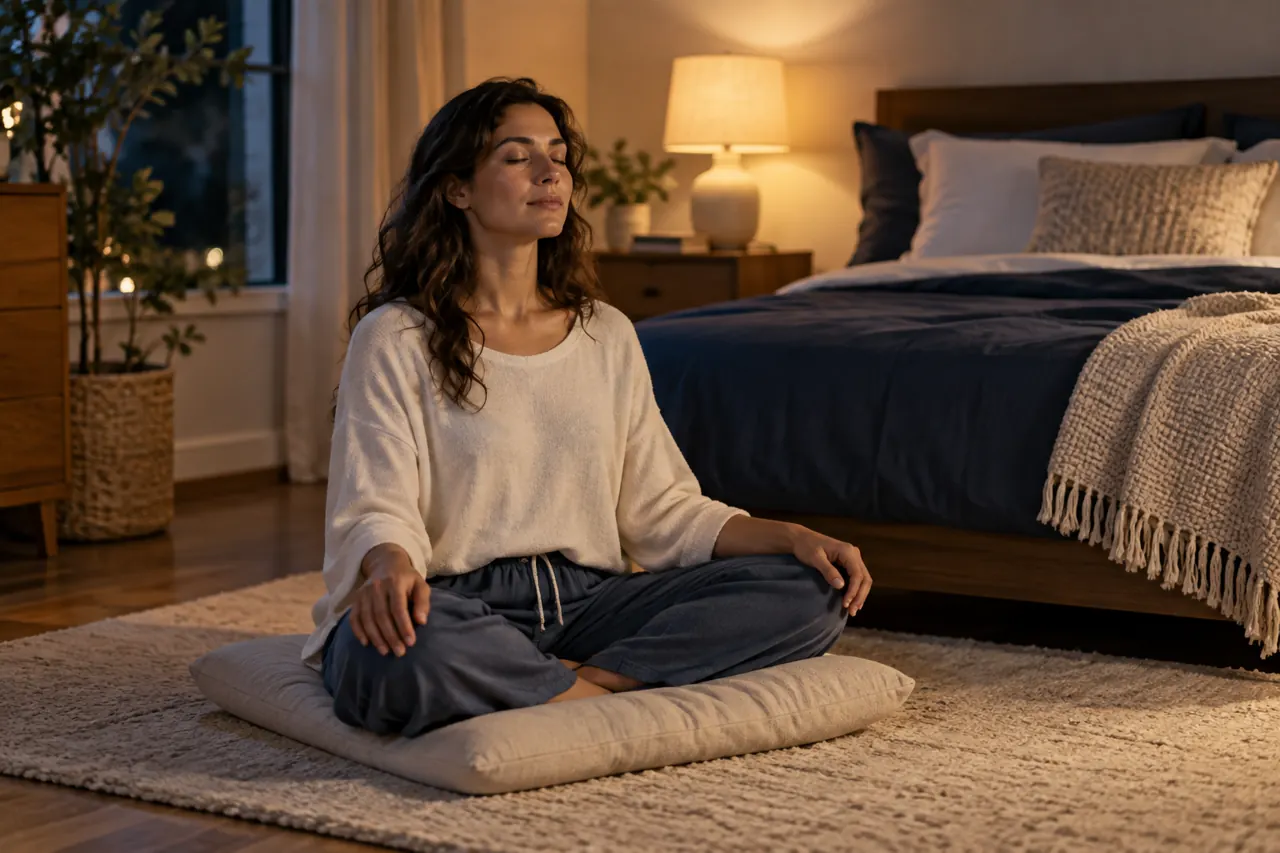
What the Panic Button Insomnia Reset does
You press start and follow a circle that grows as you breathe in, stays large as you hold and shrinks as you breathe out. A large countdown shows the seconds left in each phase, so you do not have to count. The page is dark on purpose, so it does not wake you further, and it has no sound.
You can pick the classic 4 7 8 pattern, a gentler 4 4 6 pattern or a simple 5 in, 5 out pattern. Choose the number of rounds, from four to eight. A full run takes between one and a half and three minutes.
Why you wake at 3 AM
Sleep gets lighter in the second half of the night, and REM sleep takes up a bigger share. Brief awakenings are normal and most people have several each night without remembering. The problem starts when you notice an awakening, start thinking and cannot switch off.
Common triggers include stress, a late meal, alcohol, caffeine, a hot room, noise, pain, needing the bathroom and an irregular schedule. Alcohol is a frequent cause. It helps some people fall asleep but disrupts sleep in the second half of the night (Ebrahim and colleagues, 2013). If it happens most nights, see the insomnia guide.
How slow breathing helps
Slow breathing at around six breaths a minute or less tends to raise heart rate variability and shift the balance towards the calming branch of the nervous system. A review by Zaccaro and colleagues in Frontiers in Human Neuroscience found that slow breathing was linked with more comfort, relaxation and alertness and with less anxiety and anger.
The 4 7 8 pattern was popularised by Dr Andrew Weil. There is little research on that exact pattern for sleep, so treat it as a relaxation exercise and not as a cure. If holding your breath makes you anxious, use the gentler options. Never strain or feel dizzy. Return to normal breathing at any time.
What to do at 3 AM, step by step
- Turn the clock face away so you cannot check the time.
- Keep the lights low. Use the dark screen of this page and lower your brightness.
- Do one run of slow breathing. Let your thoughts pass without arguing with them.
- If you are not asleep after about 20 minutes, get up and sit in dim light. Read a paper book or listen to quiet audio.
- Return to bed only when you feel sleepy. Do not look at news or messages.
- In the morning, get up at your usual time and have morning light. Do not try to catch up by sleeping in for hours.
The method behind the 20 minute rule
The advice to get up if you cannot sleep comes from cognitive behavioural therapy for insomnia, known as CBT I, which is the recommended first treatment for chronic insomnia. It is based on stimulus control, which teaches the brain that the bed is for sleep. Lying awake for long periods, scrolling and worrying teaches the opposite.
You do not need to time it exactly. If you are clearly awake and frustrated, leave the bed. If you doze in and out and feel relaxed, staying in bed is fine. Over a few weeks the pattern usually improves. If it does not, speak to your doctor about CBT I, which also exists as an app and as online programmes.
Set up your room for a better 3 AM
A cool bedroom around 16 to 19 degrees Celsius, or 60 to 67 degrees Fahrenheit, suits most people. Okamoto Mizuno and Mizuno reviewed how temperature affects sleep and found that both heat and cold disturb sleep stages. Use the room temperature sleep gauge to check your setting.
Keep the room dark, use earplugs or white noise if you hear traffic, and keep a glass of water and a small night light near the bed so you do not turn on bright lights. Put your phone in another room or in a drawer.
What not to do when you cannot sleep
- Do not check the time again and again
- Do not drink coffee at 4 AM to push through
- Do not use alcohol to fall back asleep
- Do not scroll social media or the news
- Do not eat a large meal
- Do not lie in bed for hours getting angry at yourself
When to ask for help
See a doctor if sleep problems last more than three nights a week for three months, if you wake gasping or choking, if you snore loudly, if you feel low most of the day or if you rely on alcohol or tablets to sleep. This page offers general self help and is not a treatment for a medical condition.
An evening routine that makes 3 AM less likely
Prevention beats the middle of the night reset. Keep a steady bedtime and wake time all week, because irregular sleep makes light sleep and early waking more likely. Finish caffeine about eight hours before bed if you are sensitive, since Drake and colleagues found that even six hours was not enough to protect sleep after 400 mg.
Make the last hour calm. Dim the lights, put your phone away and do something that does not need decisions, such as a bath, stretching or reading on paper. Write tomorrow's tasks on a list, which gives your mind permission to let go. Many people find a worry diary at 8 PM keeps worries out of the bedroom at 3 AM.
If a partner, a child or noise wakes you
Not every awakening comes from stress. Snoring partners, children, pets, traffic and bright street lights all break sleep. Try earplugs, white noise, a sleep mask and blackout curtains, and talk to your partner about snoring, which can be a sign of sleep apnoea that deserves a check. If a child wakes you, the new parent night splitter shows how two adults can share the night.
If your own thoughts wake you, keep a notepad by the bed. Write down the thought in a few words and let it go until morning. If the thought comes back, tell yourself it is on the list.
Frequently Asked Questions
Does 4 7 8 breathing work for sleep? ›
It can help you relax, and many people like it, but there is little research on that exact pattern. Slow breathing in general has support for calming the body.
Why do I wake up at 3 AM every night? ›
Common causes include stress, alcohol, caffeine, noise, heat, pain and an irregular schedule. Frequent waking can also be linked to sleep apnoea or other conditions, so ask a doctor if it keeps happening.
How long should I lie awake before getting up? ›
About 20 minutes is the usual rule. If you are relaxed and drifting, you can stay.
Is it bad to look at the clock? ›
Checking the time raises worry and makes it harder to fall asleep. Turn the clock away.
Can I use this tool every night? ›
Yes. It is a simple relaxation exercise. If you need it most nights, talk to a doctor about the cause.
Does the page need an internet connection? ›
It needs one to load. After that, the breathing loop runs in your browser without sending data anywhere.
Written by F.A and last updated on 5 November 2026. Claims are checked against the peer reviewed papers and public health sources listed below, and findings from small or early studies are labelled as such. We follow our editorial policy and explain how times and results are calculated in our methodology. Calculators run in your browser and store nothing. Found an error? Tell us and we will correct it.
Sources
- Zaccaro A et al. How breath control can change your life: a systematic review on psycho physiological correlates of slow breathing. Front Hum Neurosci 2018
- Ebrahim IO et al. Alcohol and sleep I: effects on normal sleep. Alcohol Clin Exp Res 2013
- Okamoto Mizuno K, Mizuno K. Effects of thermal environment on sleep and circadian rhythm. J Physiol Anthropol 2012
- American Academy of Sleep Medicine. Behavioral and psychological treatments for chronic insomnia (clinical guideline)
- Watson NF et al. Recommended amount of sleep for a healthy adult. Sleep 2015
This page gives general information for adults and is not medical advice. If you have ongoing sleep problems, loud snoring, breathing pauses or heavy daytime sleepiness, speak to a doctor. Times and results are estimates.