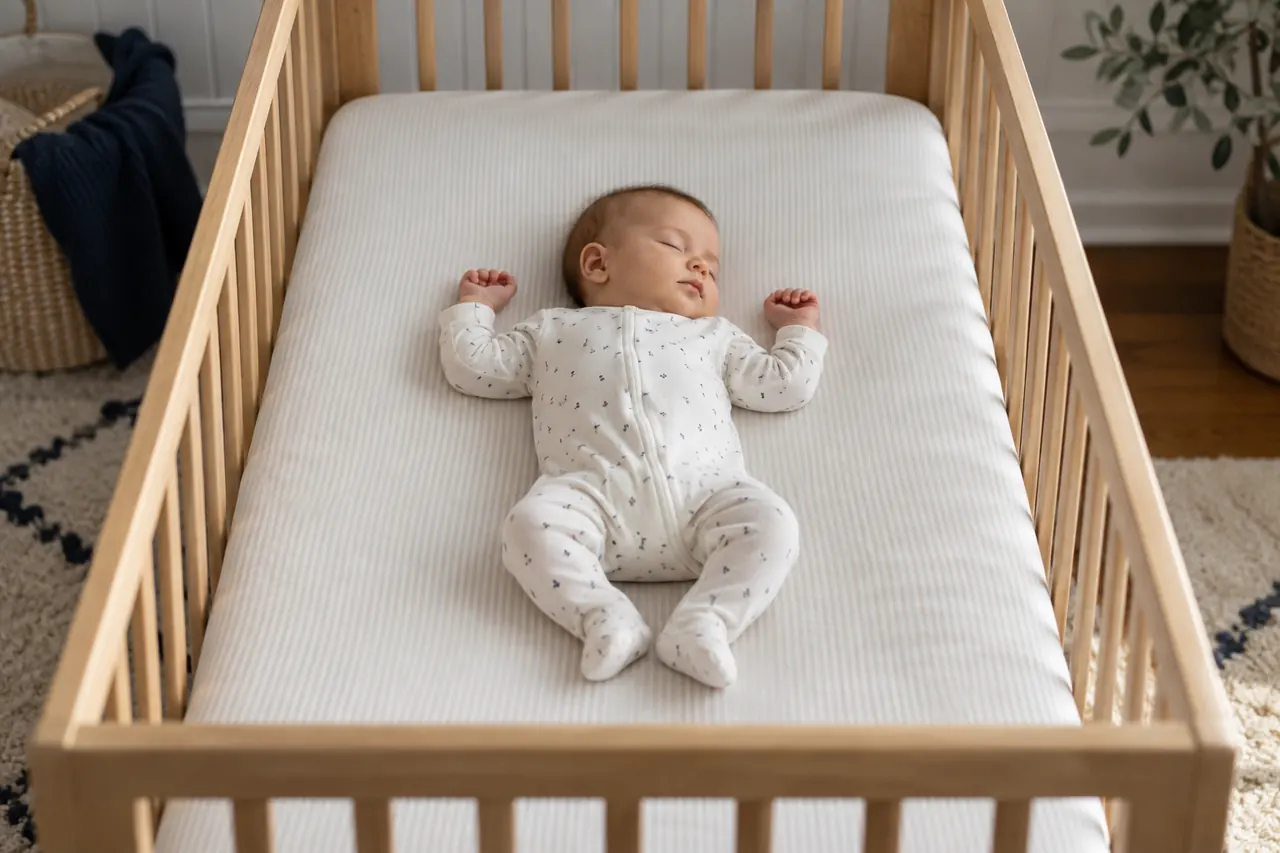
What safe sleep means
Sleep related infant deaths include sudden infant death syndrome and accidental suffocation. The American Academy of Pediatrics updated its recommendations in 2022 to reduce these risks. The advice is clear and the same for naps and night sleep.
The goal of this guide is to make the rules easy to follow, especially when parents are tired. It does not replace advice from your paediatrician or midwife.
The core rules
- Place your baby on their back to sleep, every time.
- Use a firm, flat, non inclined sleep surface with a fitted sheet, such as a cot, bassinet or play yard that meets safety standards.
- Keep the baby in your room, close to your bed, for at least the first 6 months, but on a separate surface.
- Keep the sleep area clear of pillows, blankets, bumpers, soft toys and positioners.
- Avoid overheating and do not cover the baby's head.
- Avoid smoke exposure during pregnancy and after birth.
- Offer a pacifier at sleep time once feeding is established, if it suits your family.
- Never let a baby sleep on a sofa, armchair or in an adult's arms if you could fall asleep.
If you feel yourself falling asleep during a feed
Exhaustion is the most common reason parents fall asleep with a baby. Plan ahead. Feed in a chair away from soft cushions, keep the bed clear of pillows and blankets, and move the baby to their own space the moment you start to nod. If you feel too tired to stay awake, ask your partner or another adult to take over.
The new parent night shift splitter builds a roster so that the awake parent is clearly responsible during each feed, which lowers the chance of a tired mistake.
Back sleeping and what we know about different groups
The back to sleep message has cut sleep related deaths worldwide. Some research looks at special groups. For example, a November 2026 report described an analysis of polysomnograms from 261 newborns in intensive care and said back sleeping did not worsen apnea in that group, with one exception. That finding applies to monitored babies in hospital. It should not change home advice, and parents of babies with medical conditions should follow their care team.
For healthy babies at home, the recommendation stays the same. Back to sleep on a flat firm surface.
Room temperature and clothing
Dress the baby in light layers and use a wearable sleep sack instead of loose blankets. A comfortable room is around 68 to 72F (20 to 22C) in many US sources. Check the baby's chest or back of the neck, which should feel warm and dry. See the bedroom temperature gauge for adult comfort, and follow the baby guidance above for the nursery.
If your baby is sweaty or has a flushed face, remove a layer.
Feeding and safe sleep
The AAP recommends breastfeeding where possible because it is linked with a lower risk of sudden infant death. Feeding at night is part of normal infant life, so plan for safe feeding positions that do not rely on being awake all night.
If you give bottles, use the same safe sleep rules after each feed. Do not prop a bottle or let the baby fall asleep with one in an unsafe position.
Tips for relatives, childminders and nurseries
- Share the rules with everyone who cares for the baby
- Ask childminders to follow back to sleep and a bare cot
- Do not accept soft nest style sleepers or inclined sleepers
- Keep pets and older children out of the baby's sleep space
- Replace old cots that do not meet current safety standards
Where to get help
This page is general education and not medical advice. If you have ongoing sleep problems, loud snoring, breathing pauses or severe daytime sleepiness, speak to a doctor. If your baby is unwell, breathing in an unusual way or turning blue, call emergency services right away.
Your paediatrician, midwife or health visitor can answer questions about sleep for premature babies, reflux and other medical conditions.
Common questions from tired parents
Many parents ask whether a baby who rolls over can stay on their front. Once a baby can roll both ways on their own, you do not need to turn them back, but you should still start every sleep on the back. Others ask about car seats and swings. These are for travel and awake time, and a baby who falls asleep in one should be moved to a flat surface as soon as it is safe.
Smart monitors and wearables that claim to prevent sudden infant death are not a substitute for the safe sleep rules, and their claims are often not backed by strong evidence.
Frequently Asked Questions
Which position is safest for a baby to sleep? ›
On the back, for every sleep.
Can my baby sleep in my bed? ›
The AAP advises room sharing without bed sharing. Never share a sofa or armchair.
When can a baby sleep with a blanket? ›
Keep soft bedding out of the sleep area, usually until after 12 months, and follow your doctor's advice.
Are bumpers safe? ›
No. Bumpers and soft items are not recommended.
How warm should the nursery be? ›
Many US sources suggest 68 to 72F (20 to 22C), with light layers.
Does swaddling help? ›
Swaddling is a choice, but stop when the baby shows signs of rolling, and always place the baby on their back.
Written by F.A and last updated on 5 November 2026. Claims are checked against the peer reviewed papers and public health sources listed below, and findings from small or early studies are labelled as such. We follow our editorial policy and explain how times and results are calculated in our methodology. Calculators run in your browser and store nothing. Found an error? Tell us and we will correct it.
Sources
- Moon RY et al. Sleep related infant deaths: updated 2022 recommendations for reducing infant deaths in the sleep environment. Pediatrics 2022
- American Academy of Pediatrics. Safe sleep for babies (HealthyChildren.org)
- Hirshkowitz M et al. National Sleep Foundation's sleep time duration recommendations. Sleep Health 2015
This page gives general information for adults and is not medical advice. If you have ongoing sleep problems, loud snoring, breathing pauses or heavy daytime sleepiness, speak to a doctor. Times and results are estimates.