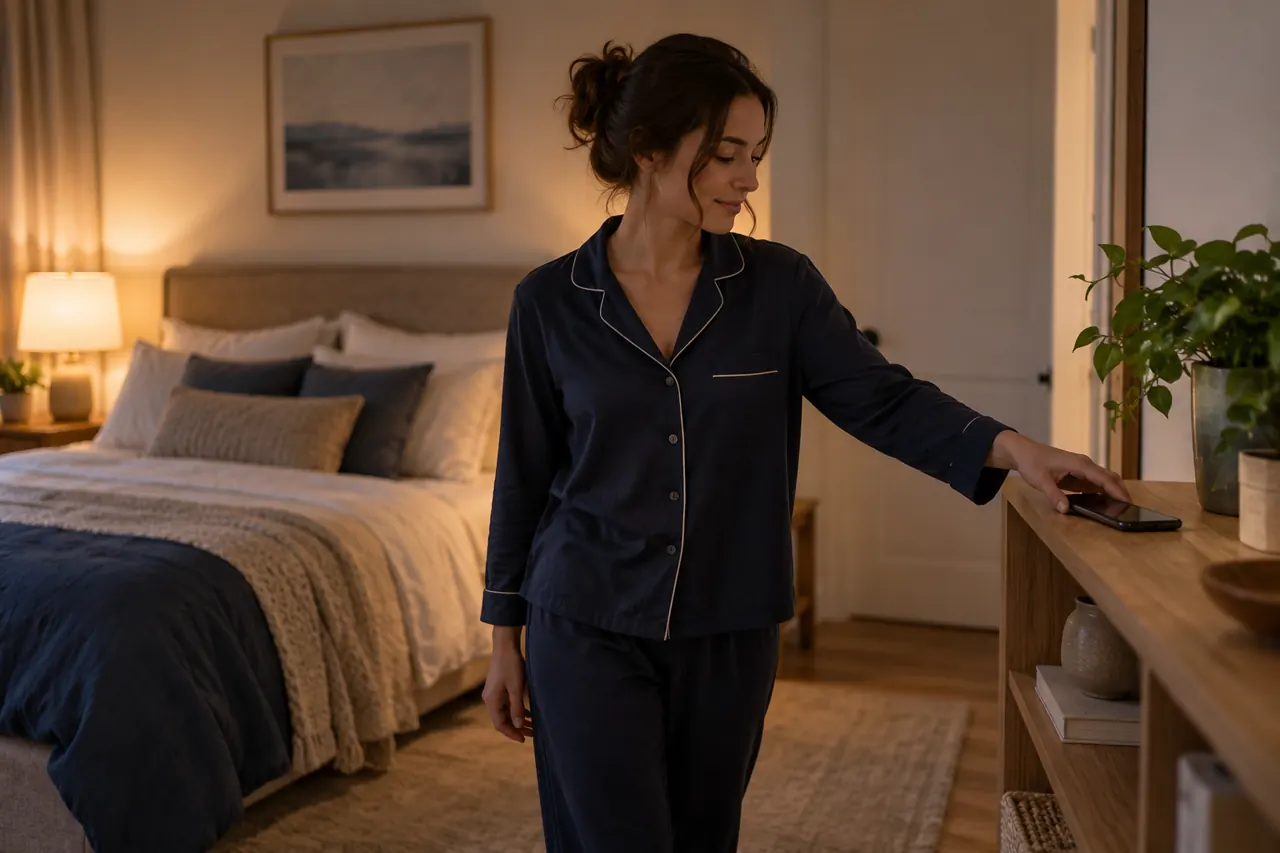
What the blue light taper timer does
Rather than telling you to stop using screens at some vague time before bed, the timer works backward from your bedtime. It lists when to switch on a warm filter, when to turn down brightness, when to finish email and news, when to move the phone out of reach and when to turn lights out.
You can choose a gentle three hour taper or a stricter four hour taper, and the advice changes slightly for a phone, a laptop or a TV.
What the research says about evening light
Chang and colleagues compared reading on a light emitting tablet with reading a printed book for four hours before bed on five evenings. Tablet readers took longer to fall asleep, had lower evening melatonin, a delayed body clock and were less alert the next morning.
This does not mean every screen ruins sleep. Dose, timing and brightness matter. A dim screen for a short time has much less effect than a bright one for hours, and the content you watch matters too.
Is blue light the whole story?
Short wavelength light, which looks blue, is the strongest signal for the body clock because of a pigment in the eye. Warm filters reduce it. But evidence that night mode on its own improves sleep is mixed. Bright room lights, stimulating content and late hours all push in the same direction.
The safest approach is the combination in the taper. Lower brightness, warm light, calmer content and an earlier finish.
Why content and habits matter as much as colour
A thriller, a work message or a tense news story keeps the brain alert whatever the colour of the screen. Social media feeds invite one more scroll. For many people the habit of staying up with the phone is a bigger problem than the light itself, which is sometimes called bedtime procrastination. See the bedtime procrastination calculator.
Choose calm content in the last hour, or swap the screen for a paper book, a podcast with the screen off or stretching.
Screens and children
Children and teenagers are more sensitive to evening light, and many keep devices in the bedroom. Set a household rule that phones charge outside bedrooms, and give teens a clear taper time that is a little earlier than their bedtime. The American Academy of Sleep Medicine recommends 8 to 10 hours for teens and 9 to 12 hours for school age children.
Lead by example. Parents who put their phones away earn the right to ask the same from their children.
Practical tips to make the taper stick
- Set a daily alarm that tells you when the taper starts
- Use a warm filter that turns on automatically at sunset
- Keep a book or a podcast ready for the last hour
- Charge the phone outside the bedroom and use a basic alarm clock
- Use lamps, not ceiling lights, in the evening
- Do the same calm routine every night
Use light in the morning to help the evening
Bright light in the morning is the other half of the plan. Outdoor light in the first hour after waking sets your body clock earlier, which makes sleepiness arrive sooner in the evening. Even on a cloudy day, outdoor light is many times brighter than indoor light.
If you work nights or have trouble waking, use the sunlight sleep calculator to plan your morning light.
Why a taper works better than a hard cutoff
A hard rule such as no screens after 9 PM fails because life gets in the way. A taper has several small steps, so missing one still leaves you with the others. Lower brightness at 8 PM already reduces the light dose, and moving the phone away at 10:30 PM removes the temptation to scroll. Each step is easy to do and easy to remember.
Habit research shows that tying a new action to a fixed cue works well. Link the first step to something you already do, such as finishing dinner or washing up, and the taper starts on its own.
A sample evening with a bedtime of 11 PM
With a gentle taper, warm mode starts at 8 PM and brightness is halved. At 9 PM email and news are done and you pick something calm, such as a favourite show, a podcast or a book. At 9:30 PM the screen moves to arm length with the brightness lowered again. At 10 PM screens are off or on their lowest level, ceiling lights are dim and lamps are on. At 10:30 PM the phone goes to charge outside the bedroom, and you do your wash and stretch routine. At 11 PM lights go out.
Many people find the hardest step is the phone leaving the bedroom. A cheap alarm clock solves the excuse that you need the phone to wake up.
If you work late or on shifts
Shift workers can use the same plan by treating bedtime as the end of their own day. If you finish at 2 AM, the taper starts at 11 PM. Wear sunglasses on the way home in the morning if you can, because bright morning light tells the brain it is day and makes sleep harder. Pair the plan with the shift worker rotation adjuster.
The goal is to give the brain a dim, calm hour or two before sleep, whatever the clock says.
Staying productive without late screens
Many people stay on screens because of work. A hard stop time helps, and so does a short shutdown routine. Write tomorrow's top three tasks on paper, close the laptop, and say the day is done. This shutdown ritual lets the mind rest and takes five minutes.
If you need to be reachable, use do not disturb with an exception for key contacts. The brain relaxes when it knows it will not miss anything important.
Frequently Asked Questions
How long before bed should I stop using screens? ›
A target of 1 hour with a taper over 3 to 4 hours works well for most people.
Does night mode work? ›
It lowers blue light, but brightness, content and timing matter too.
Do blue light glasses help? ›
Evidence is mixed. Lowering brightness and finishing earlier is more reliable.
Is it OK to watch TV in bed? ›
It is better to watch in another room and keep the bed for sleep, though a dim, calm show is less harmful than a bright feed.
What about e readers? ›
Light emitting readers have effects similar to tablets. A paper book or a reader without its own light is better in the evening.
How can I stop scrolling in bed? ›
Charge the phone out of reach and use a set time for screens off.
Written by F.A and last updated on 5 November 2026. Claims are checked against the peer reviewed papers and public health sources listed below, and findings from small or early studies are labelled as such. We follow our editorial policy and explain how times and results are calculated in our methodology. Calculators run in your browser and store nothing. Found an error? Tell us and we will correct it.
Sources
- Chang AM et al. Evening use of light emitting eReaders negatively affects sleep, circadian timing, and next morning alertness. PNAS 2015
- Watson NF et al. Recommended amount of sleep for a healthy adult. Sleep 2015
- Hirshkowitz M et al. National Sleep Foundation's sleep time duration recommendations. Sleep Health 2015
- Paruthi S et al. Recommended amount of sleep for pediatric populations. J Clin Sleep Med 2016
This page gives general information for adults and is not medical advice. If you have ongoing sleep problems, loud snoring, breathing pauses or heavy daytime sleepiness, speak to a doctor. Times and results are estimates.